Watch first
Trailer
Thirty-eight seconds, cut to the film’s own score.
An animated reconstruction · 9 min
October 7: The Day
From Jerusalem-based filmmaker Shlomo Kashani, author of the documentary book October 7: Massacre, Captivity, Denial, comes October 7: The Day, an animated reconstruction of the Hamas-led attack on the kibbutzim and the Nova music festival.
Israel now stands accused of genocide, and the public argument has moved to the war that followed. The day on which that war began is dropping out of view. Kashani made this film to show what happened on that day, in the order in which it happened. The introduction to his book states the rule he works by.
Later conduct in war cannot erase what occurred on October 7, and the urgency of October 7 cannot decide unrelated later claims without evidence.
The film does not argue the case about the war. It holds to the first half of that sentence. Whatever a court decides about later events, the record of October 7 rests on its own evidence, and no later accusation can erase it, soften it or reverse it.
October 7, 2023 fell on Shabbat and Simchat Torah. In the kibbutzim along the Gaza border, children were still asleep. Near Re’im, thousands of young people were greeting the sunrise at the Nova music festival. At 06:29 the rockets came and the music stopped. Under the barrage, thousands of armed attackers crossed into Israel. Families walked to the safe room and closed the steel door. The rooms were built against rockets, not against gunmen, and the doors did not lock from inside. For hours, parents held the handles shut with their hands. Where the doors held, the attackers set the houses on fire.
At the festival people ran across open fields, crowded into roadside shelters, or tried to drive out until Route 232 jammed. Kashani writes of the festival, “A civilian gathering collapsed into slaughter, sexual violence, abduction, and silence.” More than 1,200 people were murdered that day, and 251 were abducted into Gaza. Many of them were held underground in tunnels for months, and some for years.
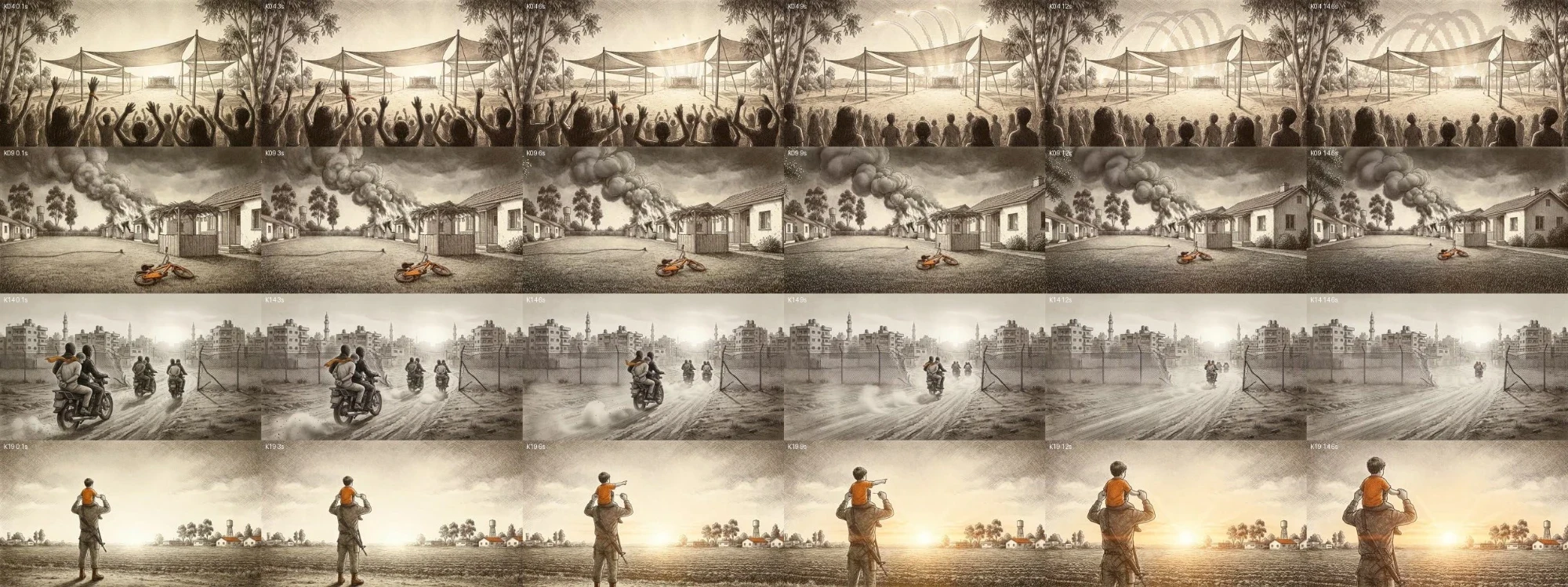
The film contains no archival footage, and its figures are not portraits of real people. Kashani animates it in the manner of his aquatint etchings, in sepia and charcoal on ivory paper. In each scene one object alone carries colour. It may be a child’s bicycle on a lawn, a festival wristband, or a crayon drawing singed at the edges. The opening note says the images are offered “as visual witness, never as spectacle”. The book sets itself the same limit. “Documentary detail is included to establish the record and its limits, never for spectacle.”
Then the film turns to what its narration calls “the second event”, what happened to the facts. The attackers killed witnesses, burned homes and carried the living and the dead across the border. Many of the bodies were burned so badly that forensic work became extremely difficult, and identifying the dead took weeks. Others later read those gaps as reasons to doubt. Kashani describes that move in the book’s prologue.
Critics were demanding intact first person testimony from victims who had been permanently silenced, and presenting that demand as the standard required for proof. The demand was structurally inverted. The attack itself had already destroyed the conditions required to satisfy it.
The book also watches the words that came later. “A massacre named as massacre preserves the attacked as civilians in memory.”
Kashani does not claim that a film or a book can undo any of this. The book’s closing chapter says what such work can do.
Truthful writing cannot reverse murder, captivity, or loss. It can preserve sequence, distinguish proof from inference, keep corrections visible, and refuse both inflation and erasure. Such work is modest beside the harm.
The film opens on a dedication to the victims that closes with a sentence from the book, “The crime and the erasure of its own proof conditions were a single act.” Before the first picture appears, the narrator asks the question the book asks. “What if an atrocity destroys the evidence that would prove it?” The book calls this evidentiary inversion. The same act produces the crime and damages the evidence needed to prove it. The film ends at dawn, on a field at the edge of a kibbutz. A soldier stands with his small son on his shoulders, and both have their backs to the viewer. The last scene has no words.
Making the film
Four shots, held open
Kashani animates the film one drawing at a time, in the manner of his aquatint etchings. This sheet shows how four of its shots were built.
Continue reading
The three editions
The film accompanies three related editions of October 7: Massacre, Captivity, Denial.